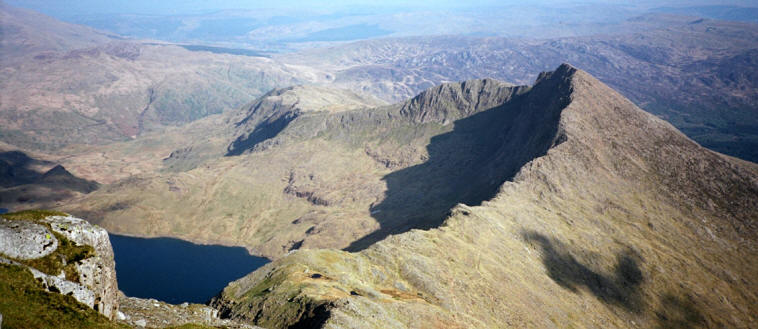
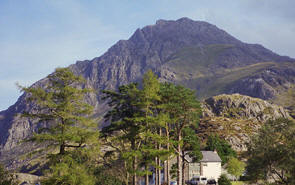
The National Three Peaks Challenge
- scroll down for the
Welsh Three Peaks +
The National Three
Peaks Challenge is a demanding endurance challenge
in which participants attempt to climb the highest
mountains in each of Great Britain's three countries,
Ben Nevis in Scotland, Scafell Pike in England and
Snowdon in Wales against the clock. Often the target
is to complete all three mountains from start to
finish within 24 hours, not surprisingly this is
called the 24 hour challenge.
The road based challenge involves approximately 10 hours of
driving, hence a successful 24 hour challenge
requires the
walkers to be able to complete up to 14 hours of strenuous mountain walking within a
24 hour period, with two "rest" periods between the
three mountains.
A Brief
History of the Three Peaks Challenge:-
Great
Britain's National Three Peaks
Challenge has steadily grown in popularity over the years and
thousands of people now undertake it every year. The very first mention we are aware of of a Ben Nevis, Scafell Pike, Snowdon summit, all within 24 hours "stunt" (it was not called a challenge
in those days) was in the 1926 Journal of the Fell and Rock Climbing
Club. It was written up by Charles F Hadfield. Details may be found in the famous climbing club's archive (1926 Journal, p278) published on their website at www.frcc.co.uk. In those days it
was a complete novelty idea, and the real challenge was in motoring
between the three mountains given the road network and cars of
the day. The first attempts used Seathwaite as the starting point
for Scafell Pike, we can assume that this made the drive more
feasible, and no doubt the climbers of the Fell and Rock were very familiar with all the
routes on the mountain.
In modern times there are various different options for undertaking this "event." The majority aim to complete the challenge within 24 hours,
recording their time from
the base of the first mountain to the base of the last, but there
are no official rules on how it should be done, no official route, no official body
overseeing the challenge and no official website. It could be
said that this now very popular and diverse challenge has grown "organically" from the
very grassroots of mountaineering in the UK.
In 1971
the famous fell runner, Joss Naylor from Wasdale, completed the
challenge from sea level to sea level in just under 12 hours, and
this is probably the fastest it will ever be done, unless someone is
using a helicopter. For
more details of Joss Naylor's outstanding feat (no pun intended) see our
section on
challenge times.
We have
been involved with this mountain venture one way or another for
about 25 years now and
have experienced the mountains under many different conditions. There is plenty of information available about how to organise
a successful and safe three peaks (not all of which is totally
reliable unfortunately) and we have tried to bring together
the best advice and experience on this website.
Whats involved:-
The first
point to note is that the National Three
Peaks Challenge is not reserved for the super fit. The walking pace required
is steady and consistent rather than blisteringly fast, its an endurance
event, not a sprint. It is of
course a demanding physical challenge, but it is also a mental
challenge and success requires careful planning and
preparation.
A successful team
challenge requires good organisation and involves attention to
logistics, mountain and road navigation, driving abilities, communication, training, team work and group catering. On top of that you
will need the right equipment,
stamina, determination and a bit of good luck!
If you are planning
to have a go at the National
Three Peaks Challenge visit our main
challenge guide
page and if you require advice please don't hesitate to
give us a
call.
The vital
statistics of this mountain challenge are as follows:-
Ben
Nevis, near Fort William, Scotland - Height: 1,345m 4,411 feet
Scafell
Pike, Western Lake District, Cumbria, England - Height: 978m
3,210 feet
Snowdon,
near Llanberis North Wales - Height: 1,085m 3,560 feet
Road mileage:
450 - 500 miles
Total
ascent and descent: 2,900m 9,800 feet
Distance
to be walked: Approx. 44 km 27 miles
In
summer people often attempt to complete the challenge in under 24
hours, but there is no reason why it should not be done over a
slightly
longer period (36 hours is now a popular option) for a more enjoyable adventure which does not require
being on a mountain at night or the early hours of the morning with
its attendant increased risk and anti-social aspects. Doing it over
three consequtive days is still a strenuous challenge, but it can be more enjoyable
and perhaps less anti-social.
Most teams will find completing within 24 hours a very demanding
challenge even given ideal summer conditions and completing the
challenge in under 20 hours is really outstanding under today's road
conditions. Even in the long days of summer a 24 hour challenge
will most likely involve climbing one of the mountains (usually
Scafell Pike) at least partly at night or the early hours of the
morning. This can be avoided by
doing the challenge over 36 hours without really losing the key
elements of the challenge. Under winter conditions it is
occasionally attempted over a 3 day period by teams with appropriate
experience.
For more info. about times and
three peaks challenge records see
challenge times.
Having
the mountain walkers involved with the driving on the day in a 24
(or 36) hour challenge is a
complete non-starter - challenge teams need good drivers /
navigators to support the challenge and they are a very important
part of the team.
Navigation issues should not be underestimated. Good weatherproof
maps and a walker's compass, together with the knowledge of how to
use them properly, are vital in tackling these mountains whatever
the weather conditions. Safety and navigational accuracy is more
important than just speed. This applies equally on the mountains and
on the roads!
If you are thinking about doing the Three Peaks,
or just want to see more information and related links visit our
main
challenge guide.
Also see
our
Map List for a list of our special maps and guides for the
challenge.
The Welsh National Three Peaks Challenge
The Welsh Three Peaks
is an increasingly popular mountain expedition that encompasses three
truly iconic Welsh peaks - Pen y Fan in the Brecon Beacons National
Park - this is the
highest mountain south of Snowdonia and has been made famous as a
training ground for the SAS and the
Ghurkhas, Cadair (Cader) Idris in the south of Snowdonia - an
impressive and really
outstanding mountain to climb, and one that should never be underestimated,
and of course the highest
mountain in England and Wales, the well known Mount Snowdon in the
north of the Snowdonia National Park.
There is less
driving to do than for the National Three Peaks and if people wish
to do the Welsh Three Peaks as quickly as possible then they can be
done in less than 15 hours and for some teams this is the target. Alternatively they can be done over two
days, typically with the second day being spent on Snowdon ending
with a celebration in Llanberis.
There is a variety of interesting routes that can be used to climb
these mountains and
Beacon Maps
have
produced a new set of three weatherproof laminated mountain guide-maps
for the Welsh Three Peaks that cover the classic routes on these
three great mountains - please see
Map List for more info.
Ty-Hafan Three Peaks
Beacon Maps produce a special customised set of maps for the Ty-Hafan
Welsh Three Peaks challenge
in association with GE. These very clear but detailed weatherproof
mountain maps highlight the Ty-Hafan routes and are only available
for Ty-Hafan teams. Please contact us for details.

&
Welsh Three Peaks |
The Snowdon 500 &
Welsh Three Peaks Challenge
events in aid of Prostate Cancer Research Centre have
been an amazing success and Beacon Maps are proud to
help support these events and produce special
guide-maps. These events have raised over a
million pounds so far to help fight advanced prostate
cancer. The 2016 events had to be cancelled
unfortunately, but they were back again this year. More
info from their website.
To get
involved or to get more info visit
Snowdon500.
|
The Yorkshire Three
Peaks
The
well known
Yorkshire Three Peaks walk
in the Yorkshire Dales National Park can be completed in less than 12 hours without using road transport and
hence in some ways is a "purer" challenge than the National Three
Peaks. There is also an annual Three Peaks Fell Race, the record time is believed to be 2h 29min set by Jeff Norman in
1974. Even though the three Yorkshire peaks of Pen-y-ghent, Whernside and Ingleborough are all well below 2,500 feet
some people regard completing the Yorkshire Three Peaks walk to be more
challenging in some respects than the National Three Peaks 24 hour
challenge. Much of the well used Yorkshire Three Peaks route is on reasonably good paths which
have been repaired or remade in recent years, but some sections are
very, very boggy, especially the section from Pen-y-Ghent down to
Jackdaw Hill. Recently a new route has been created that
avoids the most boggy sections - see
full story.
Most walkers start and
end the walk at Horton-in-Ribblesdale and the famous Pen-y-ghent
Café, which is also the local information centre in the village, has for many years operated a clocking in and out
system for Three Peaks walkers. If you complete within 12
hours you will be invited to join their Three Peaks of Yorkshire Club.
The café is run by the Bayes family and they have a good range
of maps and guides for sale and they are a good source of helpful advice
for walkers. If you ask nicely they may mark up one of the maps for
you with the best
(and up to date) Three Peaks route - don't forget to use a map case to protect the map
from the elements.
There are
several maps available for the Yorkshire Three Peaks at various
scales, including one in the Harvey Superwalker series at 1:25,000. We plan to add
more information and maps for the Yorkshire Three Peaks shortly.
Other
UK Mountain Challenges
Our upland environment provides endless
scope for devising anything from a pleasant afternoon stroll to a challenging
multi-day "expedition." The National Three Peaks have been completed using cycle transport between
the mountains, by relays of runners and by using only public transport.
The challenge can be
extended to the whole of the UK by including Slieve Donard, the highest point in Northern
Ireland. A further extension makes the challenge an
"International 5 Peaks Challenge" by also including the
highest mountain in the Republic of Ireland, Carrauntoohil in the
MacGillycuddy's Reeks, Co. Kerry. Occasionally this is done using helicopters
for transport between the mountains! In the UK a charity called the
Railway Children organises a unique Three Peaks by rail every year
and
there is also an annual Barmouth to Fort William
Three Peaks Yacht Race held in late June. |